From Dialogue to Impact: SOS-Water Engages Stakeholders in the Mekong Delta
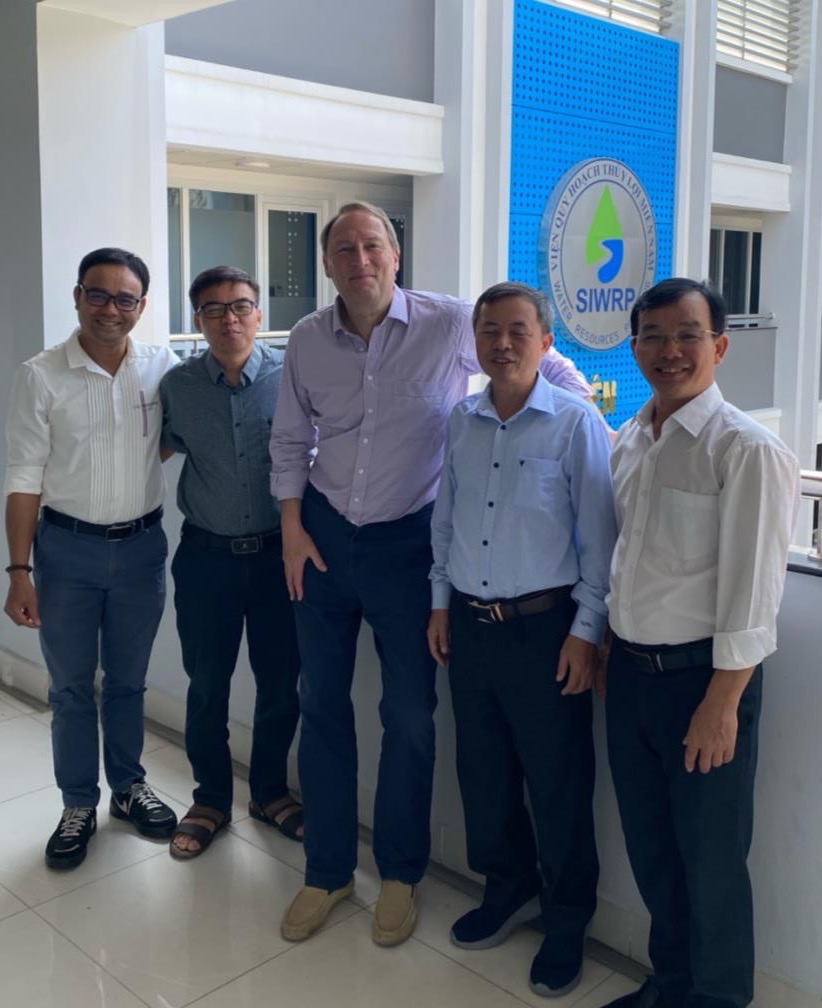
In April 2026, the SOS-Water project convened its 3rd Stakeholder Engagement Workshop for the Mekong Delta in Ho Chi Minh City, hosted by the Southern Institute for Water Resources Planning (SIWRP). Bringing together around 25 stakeholders from research institutions, governmental bodies, and sectoral organisations, the workshop marked a critical milestone in translating scientific progress into practical, policy-relevant insights.
A Structured Dialogue on Water Challenges
The workshop followed a carefully designed agenda that combined scientific presentations with interactive discussion. Key sessions covered:
- The SOS-Water project overview and framework
- Development of indicators and thresholds
- Evaluation of baseline scenarios
- Identification of future adaptation pathways
- Insights into local water security challenges
- A dedicated stakeholder discussion session
This structure ensured a balance between knowledge transfer and stakeholder exchange — central to the SOS-Water approach.
A Turning Point: From Concepts to Results
As highlighted during the event, this third workshop represented a clear shift in the project's trajectory. Earlier engagements focused on defining indicators and thresholds. Now, the project is delivering concrete modelling results and scenario simulations for the Mekong Delta, strengthening both scientific credibility and stakeholder confidence.
Dang Thanh Lam, Director of the Southern Institute for Water Resources Planning (SIWRP), who organised the workshop, described this transition as a moment of growing confidence:
The project has moved from defining concepts to sharing real assessment results and simulations, allowing stakeholders to better understand and engage with the outcomes.
This progression reflects the core ambition of SOS-Water: moving from theory to operational tools that support decision-making.
Science Meets Stakeholder Reality
A central highlight of the workshop was the presentation by Mikael Muegge (EUTEMA Research Services), who shared preliminary results of the SOS-Water project and demonstrated how the Safe Operating Space (SOS) framework is becoming operational.
The presentation emphasised:
- The integration of models, indicators, and stakeholder input
- The application of the framework across multiple case studies, including the Mekong
- The development of decision-support tools and visualisation platforms
- A strong focus on policy relevance and actionable outcomes
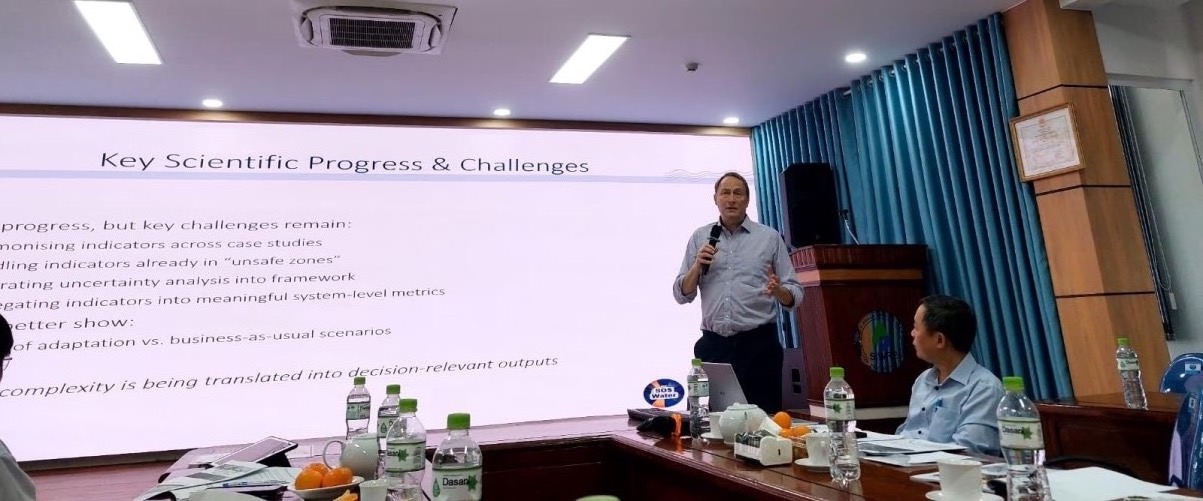
Importantly, the project is no longer conceptual — it will be applied in real-world basins, including the Mekong Delta.
Why Stakeholder Engagement Matters
The workshop reaffirmed that stakeholder participation is not an add-on — but a foundation of the SOS-Water approach.
As Lam emphasised during the discussion:
- Effective water management requires multi-dimensional assessment
- This can only be achieved by integrating expert knowledge across sectors
- Stakeholders play a key role in co-developing indicators, scenarios, and solutions
This participatory process ensures that scientific outputs are aligned with real-world needs, priorities, and constraints.
Addressing Urgent Challenges in the Mekong Delta
The Mekong Delta faces a complex combination of water-related pressures, many of which were central to the workshop discussions:
- Increasing flood and drought risks
- Salinity intrusion and water quality challenges
- Declining sediment flows
- Growing pressure on biodiversity and ecosystems
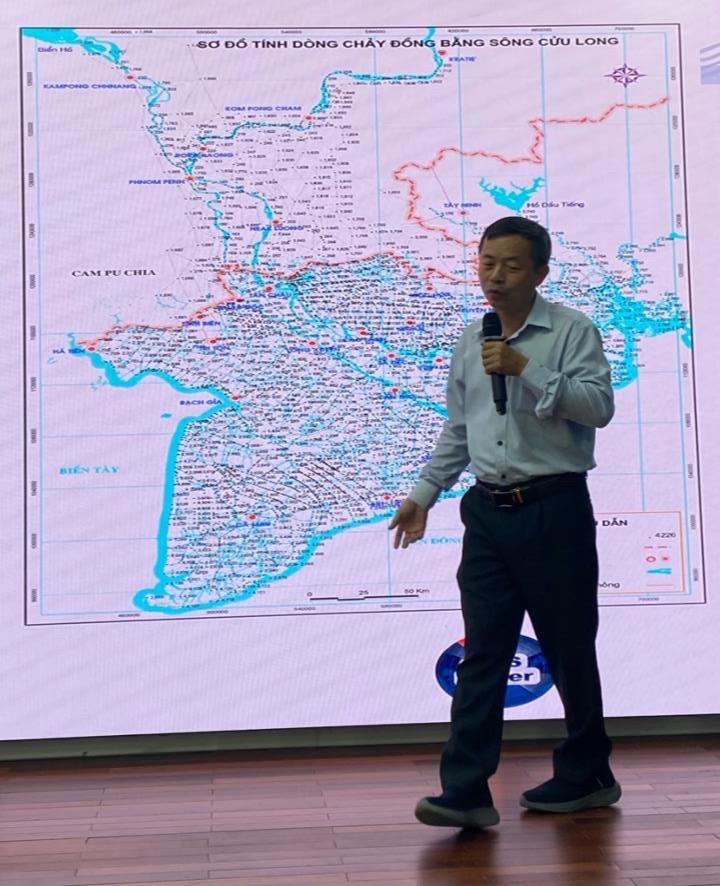
SOS-Water contributes to addressing these challenges through:
- Advanced modelling and monitoring systems
- Integration of Earth Observation data
- Development of adaptation pathways
- A holistic framework linking environmental, social, and economic dimensions
From Research to Policy Impact
A key message emerging from the workshop was the strong expectation that SOS-Water results will go beyond research.
Stakeholders expressed interest in:
- Applying the SOS framework in national water planning
- Using project tools to support decision-making and investment strategies
- Integrating results into climate adaptation and policy processes
The long-term vision is clear: to translate SOS-Water methodologies into policy and planning frameworks that support sustainable development in Vietnam.
Looking Ahead
The workshop concluded with a forward-looking discussion on the next steps:
- Continued refinement of scenario simulations and indicators
- Strengthening stakeholder collaboration
- Advancing the integration of results into policy frameworks
As the project enters its final phase, stakeholder engagement remains a cornerstone for ensuring that results are not only scientifically robust — but also usable, relevant, and impactful.
Conclusion
The 3rd Mekong stakeholder workshop demonstrated how SOS-Water is successfully bridging the gap between science and practice.
By combining advanced modelling, stakeholder knowledge, and policy-oriented thinking, the project is helping define a safe operating space for water resources — not just as a concept, but as a practical tool for real-world decision-making.
The project has moved from defining concepts to sharing real assessment results and simulations, allowing stakeholders to better understand and engage with the outcomes. — Dang Thanh Lam, SIWRP